The Short Answer
Tandoori refers to any food cooked in a tandoor, a cylindrical clay oven that reaches temperatures up to 480°C (900°F). The word does not describe a single dish or a spice blend. It describes a cooking method that produces a flavor profile no other technique can replicate: smoky, charred, slightly dry on the surface, and intensely juicy within.
When you order "tandoori chicken" at a restaurant, you are eating chicken that was marinated in spiced yogurt and cooked at extreme heat inside a clay oven. The tandoor is the defining element, not the red color or the spice mix.
A 5,000-Year-Old Oven
The tandoor is one of the oldest cooking devices still in daily use. Archaeological evidence from the Indus Valley civilization (around 3000 BCE) shows clay ovens remarkably similar to modern tandoors. The design has survived because it works extraordinarily well.
The modern tandoor entered mainstream Indian restaurant culture through a specific story. In 1947, during the Partition of India, Kundan Lal Gujral migrated from Peshawar (now in Pakistan) to Delhi. He brought his family recipe for tandoori chicken and opened Moti Mahal restaurant in the Daryaganj neighborhood. Moti Mahal popularized tandoori chicken across India and, eventually, the world. Gujral is also credited with inventing butter chicken by simmering leftover tandoori chicken in a tomato-cream sauce.
Before Partition, tandoori cooking was primarily a Punjabi and Northwest Frontier tradition. After 1947, it became a pan-Indian restaurant staple.
How a Tandoor Works
A traditional tandoor is a bell-shaped clay pot, roughly 1 meter tall, insulated with layers of clay, straw, and sometimes concrete. Charcoal or wood burns at the bottom. The design creates three simultaneous cooking methods:
- Radiant heat from the glowing charcoal and superheated clay walls (the primary cooking force)
- Convection from hot air circulating inside the enclosed chamber
- Smoke from fat and marinade dripping onto the coals below
The Physics of Tandoori Flavor
The intense heat triggers the Maillard reaction (browning) and caramelization at a rate impossible in a conventional oven. The yogurt in the marinade contains sugars and proteins that brown rapidly, creating that distinctive crust. Fat dripping onto the coals generates smoke that rises and flavors the food. The enclosed shape traps this smoke, creating a natural smoking chamber.
This combination of char, smoke, and sealed-in moisture is what makes tandoori food taste different from grilled, baked, or roasted food.
The Tandoori Marinade
Every tandoori dish starts with a marinade built on the same framework. The base has three layers:
Layer 1: The Tenderizer
Yogurt is the foundation. Its lactic acid breaks down surface proteins, allowing the spices to penetrate deeper and creating a tender exterior that chars beautifully. Most recipes call for full-fat yogurt, hung (strained) to remove excess moisture. The marinating time ranges from 2 hours to overnight, depending on the protein.
Layer 2: The Spice Blend
A standard tandoori spice mix includes:
| Spice | Purpose |
|---|---|
| Kashmiri red chili | Color (vibrant red-orange without extreme heat) |
| Cumin | Earthy base note |
| Coriander | Warm, citrusy depth |
| Garam masala | Aromatic complexity |
| Turmeric | Golden undertone, mild earthiness |
| Amchur (dried mango powder) | Tanginess |
| Kasoori methi (dried fenugreek) | Savory, slightly bitter finish |
Layer 3: The Fat
Mustard oil or ghee gets mixed into the marinade. The fat carries fat-soluble flavor compounds from the spices, distributes heat evenly during cooking, and prevents the surface from drying out too quickly.
Classic Tandoori Dishes
The tandoor produces far more than chicken. Here are the dishes that define tandoori cooking:
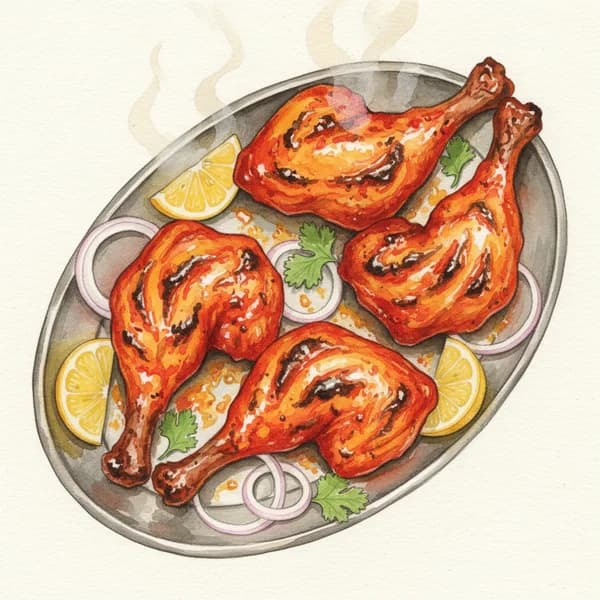
Tandoori Chicken is the original. Whole chicken legs, scored to the bone, marinated for 6 to 8 hours, then cooked on long skewers inserted vertically into the tandoor. The skin chars and crisps. The meat stays juicy from the yogurt barrier. Chicken Tikka uses boneless pieces rather than bone-in cuts. The smaller pieces cook faster and develop more surface char per bite. Tikka masala, the British-Indian dish, was born from leftover chicken tikka simmered in a spiced tomato-cream sauce. Seekh Kebab is spiced minced meat (usually lamb or goat) shaped around flat metal skewers and cooked inside the tandoor. The fat in the mince bastes the kebab as it cooks, and the direct contact with the hot skewer creates an internal crust. Naan is leavened bread dough slapped directly onto the inner wall of the tandoor. The dough sticks to the superheated clay, puffs up in seconds, and develops charred bubbles on the surface that faces the coals. This is why restaurant naan tastes different from anything you can bake at home in a conventional oven. Tandoori Roti is similar to naan but made with whole wheat flour and no leavening. It is the everyday bread of Punjabi homes that have access to a tandoor. Paneer Tikka is the vegetarian counterpart to chicken tikka. Cubes of paneer, bell pepper, and onion are marinated and skewered. The paneer develops a golden crust while staying soft inside. Tandoori Fish (often pomfret or salmon) is marinated in a variation that includes mustard paste or ajwain (carom seeds) to complement the fish flavor. The high heat cooks the fish in 5 to 7 minutes without drying it out.Tandoori vs. Tikka: The Difference
These two terms get used interchangeably in many restaurants, but they are not the same.
Tandoori refers to bone-in pieces (often a whole leg or half chicken) cooked in the tandoor. The bone slows down cooking, keeping the meat juicier. A tandoori chicken portion is a large, dramatic piece of food. Tikka means small, boneless pieces. The word "tikka" literally translates to "bits" or "pieces." Chicken tikka, paneer tikka, and fish tikka are all bite-sized cubes threaded onto skewers.Both use similar marinades and the same tandoor. The difference is the cut, the cooking time, and the presentation.
How to Get Tandoori Flavors at Home
You do not need a clay oven to achieve 80% of the tandoori flavor profile. Here are three methods, ranked by effectiveness:
Method 1: Oven Broiler (Best Overall)
Set your oven rack 6 inches below the broiler element. Place marinated meat on a wire rack over a foil-lined baking sheet. Broil on high for 8 to 10 minutes per side, until the edges char and blacken in spots. The wire rack allows air circulation, and the broiler provides the closest thing to radiant tandoor heat. Finish with a squeeze of lemon and a brush of melted butter.
Method 2: Charcoal Grill (Best Flavor)
A charcoal grill with the lid closed comes closest to replicating tandoor conditions. Bank the coals on one side for a hot zone (direct heat for charring) and a cool zone (indirect heat for cooking through). Grill the marinated pieces over direct heat for 3 to 4 minutes per side, then move to indirect heat until cooked through. The charcoal smoke adds authentic flavor that no oven can match.
Method 3: Cast Iron Skillet + Oven
Sear marinated pieces in a smoking-hot cast iron skillet for 2 minutes per side to develop char. Then transfer the skillet to an oven preheated to 230°C (450°F) for 10 to 15 minutes. This two-step method gives you good char and even cooking.
The Dhungar Method (Smoke Infusion)
For any home method, you can add a final layer of smokiness using dhungar. Place a small metal bowl or piece of foil in the center of your cooked tandoori dish. Drop a piece of hot charcoal into the bowl, pour half a teaspoon of ghee over the charcoal, and immediately cover the pot with a tight lid. Let the smoke infuse for 2 to 3 minutes. This technique adds the last 10% of tandoor authenticity.
The Red Color: Myth vs. Reality
Authentic tandoori food gets its color from Kashmiri red chili powder, a mild chili variety that produces a deep red-orange hue without excessive heat. Traditional tandoori chicken is a warm burnt orange, not the fluorescent red you see in many restaurants.
That bright red color comes from artificial food coloring (usually Red 40 or a combination of red and yellow dyes). Restaurants add it because customers have come to associate "tandoori" with "bright red." It adds nothing to the flavor.
If you are making tandoori at home, skip the food coloring entirely. Use 2 to 3 tablespoons of Kashmiri chili powder per kilogram of meat for authentic color. If you cannot find Kashmiri chili, a mix of sweet paprika (for color) and a small amount of cayenne (for heat) works as a substitute.
Some recipes also add a pinch of turmeric and a tablespoon of tomato paste, which together produce a natural red-orange tone close to the original.
Tandoori Cooking Beyond India
Tandoori cooking has spread far beyond its Punjabi origins. The tandoor is now standard equipment in restaurants across the UK, US, Canada, the Middle East, and Southeast Asia. British Indian cuisine elevated tandoori chicken to a national dish. In 2001, then-Foreign Secretary Robin Cook famously called chicken tikka masala "a true British national dish."
Central Asian and Middle Eastern cuisines use similar clay ovens (called tandir, tannur, or taboon depending on the region). The Turkish tandir kebab, the Iraqi tannur bread, and the Uzbek tandyr nan all share the same ancient lineage as the Indian tandoor.
Start Cooking
The tandoor is a simple technology that produces extraordinary results. You do not need the oven itself to understand the principles: high heat, yogurt-based marinades, and the interplay of char and smoke.
Try our butter chicken recipe, which starts with tandoori-style chicken. Explore the spice guide to learn more about Kashmiri chili, garam masala, and the other spices that define tandoori marinades. And read our guide to understanding masala to see how tandoori masala fits into the broader Indian spice blending tradition.