The Cuisine of Contrasts
Gujarati food operates on a principle that confuses outsiders: nearly every savory dish has a touch of sweetness. The dal has jaggery. The kadhi has sugar. Even some sabzis include a pinch of something sweet. This is not an error or an excess. It is a deliberate, sophisticated balancing act that, once you understand it, reveals a cuisine of remarkable depth.
Gujarat is predominantly vegetarian, among the most vegetarian states in India. This constraint has produced extraordinary creativity. When you cannot rely on meat for richness and umami, you develop other strategies: fermentation, steaming, tempering, and the interplay of all six tastes.
The Sweet-Sour-Savory Philosophy
Gujarati cooking follows the Ayurvedic principle that a complete meal should include all six rasas (tastes): sweet, sour, salty, bitter, pungent (spicy), and astringent. Most Indian cuisines achieve this across the meal. Gujarati cuisine achieves it within individual dishes.
Adding a teaspoon of jaggery to dal does not make it dessert-sweet. It rounds the sour tang of tomato and the bitterness of turmeric into a harmonious whole. The sugar is not a distinct flavor. It is an equalizer.
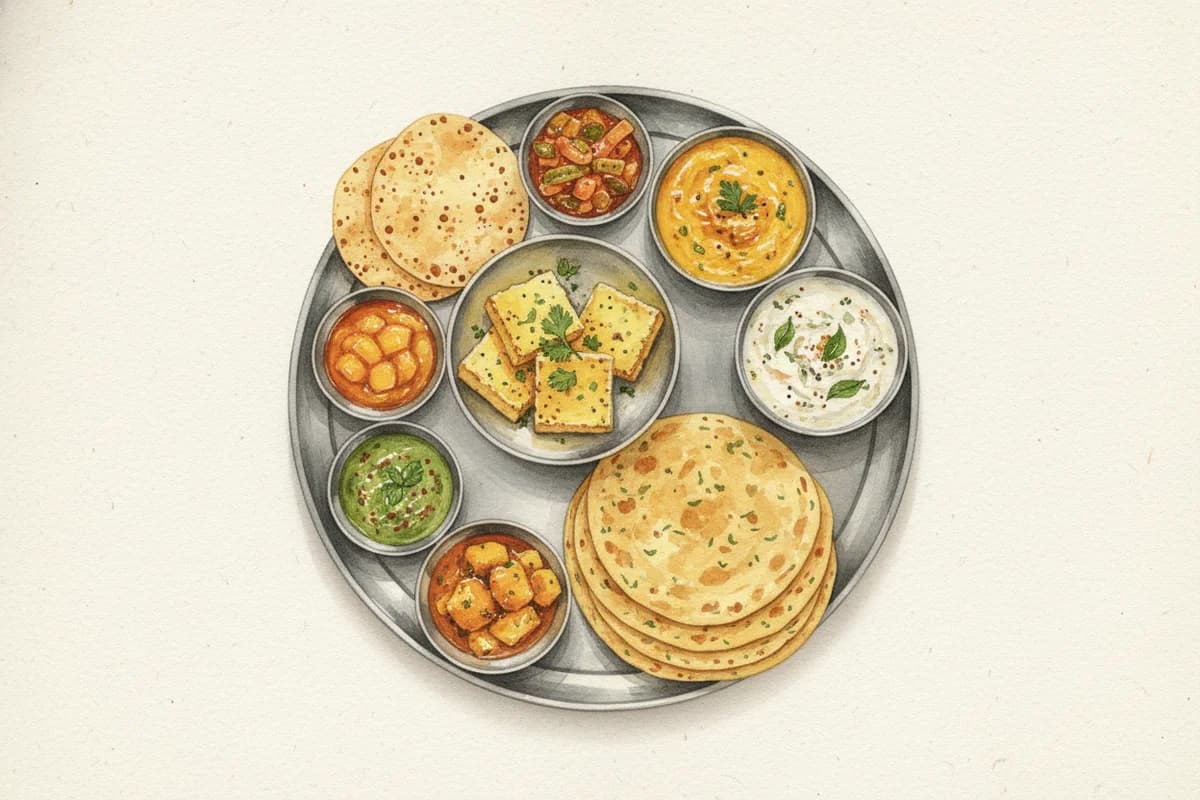
This philosophy extends to the thali, which is arguably Gujarat's greatest contribution to Indian dining culture. A Gujarati thali is a masterclass in flavor balance, with 8 to 12 dishes representing every taste and texture.
The Gujarati Thali
A full Gujarati thali typically includes:
- Rotli (thin whole wheat roti, softer than Punjabi roti)
- Rice (plain, or as khichdi)
- Dal (typically toor dal with jaggery and lemon)
- Kadhi (yogurt-based curry, sweet-sour)
- 2-3 sabzis (one dry, one with gravy, often seasonal)
- A farsan (snack item): Dhokla, khandvi, or fafda
- Papad (roasted or fried)
- Pickle (achaar, often sweet like chundo)
- Salad (simple onion-tomato or kachumber)
- Sweet (shrikhand, basundi, or a simple ladoo)
- Chaas (buttermilk, served throughout the meal)
The Signature Dishes
Dhokla
Fermented chickpea flour (besan) batter steamed into soft, spongy squares and tempered with mustard seeds, curry leaves, and green chilies. Light, protein-rich, and probiotic from the fermentation. Dhokla is Gujarat's most famous snack and one of the healthiest foods in Indian cuisine.
Khandvi
Paper-thin rolls made from a cooked chickpea flour and yogurt mixture, spread impossibly thin on a surface, cooled, rolled up, and tempered with mustard seeds and coconut. The technique is demanding, and perfect khandvi is a point of pride for Gujarati cooks.
Undhiyu
The crown jewel of Gujarati cuisine. A mixed vegetable dish traditionally made in winter with surti papdi (flat beans), purple yam, small eggplant, banana, and muthiya (spiced fenugreek dumplings), slow-cooked in an earthen pot. Every family has their recipe, and the debate over the "right" undhiyu is as fierce as any biryani argument.
Thepla
A flatbread made with whole wheat flour, chickpea flour, fenugreek leaves (methi), and spices. Theplas are the travel food of Gujarat, packed for every journey because they stay fresh for days. If you have ever traveled with a Gujarati family, you have eaten thepla from a container at 30,000 feet.
Handvo
A savory cake made from fermented rice and lentil batter mixed with vegetables and spices, baked or pan-fried until crispy on the outside and fluffy inside. It is essentially a savory, Indian version of a vegetable frittata.
Dabeli
A street food originating from Kutch. A potato filling spiced with a special dabeli masala, stuffed into a pav (bread roll), topped with pomegranate seeds, sev, and chutneys. Sweet, spicy, crunchy, soft, all in one bite.
Fafda-Jalebi
Gujarat's Sunday morning ritual. Fafda (crispy chickpea flour strips) eaten with jalebi (crispy sugar syrup spirals) and raw papaya pickle. The combination of savory, sweet, and sour eaten together is quintessentially Gujarati.
The Snack Culture
Gujarat has the most developed snack (farsan) culture of any Indian state. The variety is staggering:
- Dhokla (steamed, fermented)
- Khandvi (rolled, savory)
- Fafda (fried, crispy)
- Gathiya (chickpea flour sticks)
- Khakhra (crispy whole wheat crackers)
- Sev (thin chickpea flour noodles)
- Muthiya (steamed or fried fenugreek dumplings)
- Patra (colocasia leaves rolled with spiced batter, steamed, sliced, and tempered)
- Lilva kachori (pigeon pea stuffed pastries, seasonal)
The Cooking Techniques
The Sweet Tempering
Gujarati tadka is distinctive. Mustard seeds, cumin, curry leaves, green chilies, and often a pinch of sugar or jaggery are tempered in oil. Sometimes a small amount of hing (asafoetida) is added. The sweet note in the tempering carries through the entire dish.
Steaming
Gujarat steams more than almost any Indian state. Dhokla, khandvi, muthiya, patra, and several other preparations use steaming as the primary cooking method. This predates any modern health trend by centuries.
Fermentation
Dhokla batter, idla (a Gujarati cousin of idli) batter, and handvo batter are all fermented. This produces lighter textures, better nutrient bioavailability, and probiotic benefits. See our article on Indian fermented foods and gut health.
Minimal Spice Heat
Compared to South Indian or Punjabi cooking, Gujarati food uses less chili heat. The heat comes from green chilies (which are milder than dried red chilies) and black pepper, rather than aggressive red chili powder. This allows the other flavors, especially the sweet-sour balance, to come through.
The Cultural Context
Gujarat's vegetarianism is rooted in Jain and Vaishnavite Hindu traditions. Many Gujarati families follow strict vegetarianism that extends beyond meat to exclude onion and garlic (which Jain dietary laws consider root vegetables that harm microorganisms when harvested).
Jain Gujarati cooking achieves remarkable flavor without onion or garlic, relying instead on asafoetida (hing), ginger, green chilies, and careful spice balancing. This is one of the most restrictive ingredient sets in Indian cooking, and the results are surprisingly delicious.
The business community culture of Gujarat also shaped its food. Gujarati merchants traveled extensively, and their cuisine developed portable, shelf-stable foods (thepla, khakhra, various farsans) that could sustain long journeys.
The Bottom Line
Gujarati cuisine challenges every assumption outsiders bring to Indian food. It is subtle where Punjabi food is bold. It is sweet where most Indian food is savory. It is steamed where most Indian food is fried. And it is almost entirely vegetarian in a world that assumes protein requires meat.
The genius of Gujarati food lies in its constraints. Without meat, without aggressive heat, and sometimes without even onion and garlic, it builds flavor through balance, fermentation, and an intuitive understanding of how sweet, sour, salty, and savory can work together.
If you think vegetarian food is boring, you have not eaten Gujarati food. A full Gujarati thali will change your mind before the first refill arrives.
Explore our Gujarati recipes to start cooking this remarkable cuisine.