Ghee: Is It Healthy? What 30 Studies Tell Us
Medical Disclaimer
This content is for educational purposes only. It is not medical advice, diagnosis, or treatment. Consult your doctor or registered dietitian before making dietary changes, especially if you have a medical condition or are taking medication.
In This Article
The Most Controversial Fat in Indian Cooking
No ingredient in the Indian kitchen carries more nutritional baggage than ghee. For the better part of five decades, mainstream dietary advice told us that ghee was dangerous. Too much saturated fat, they said. Clogs your arteries. Switch to vegetable oil.
Indian families listened. Many replaced their grandmother's brass ghee container with plastic bottles of refined oil. And yet, heart disease rates in India did not improve. They got worse.
This is not to say ghee is a miracle food. It is not. But the story is far more complicated than "saturated fat equals heart disease." Here is what the published research actually tells us.
What Is Ghee, Biochemically?
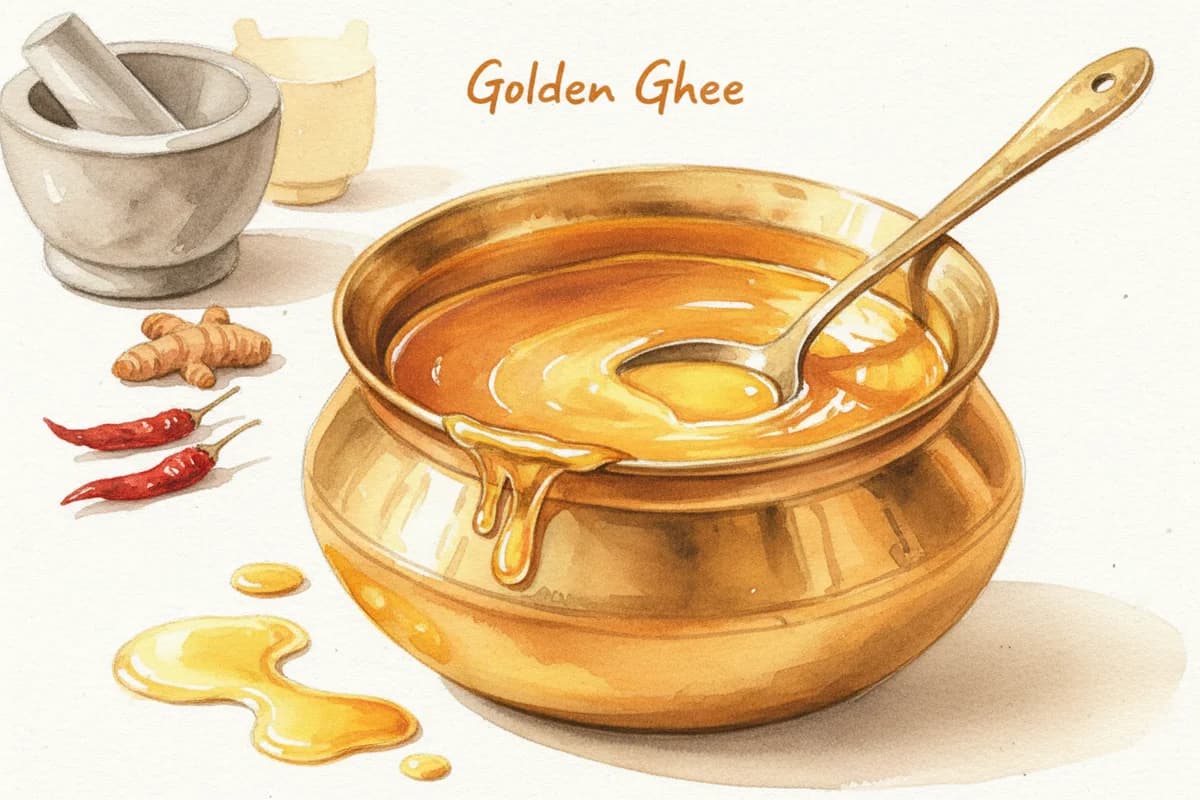
Ghee is anhydrous milk fat, produced by simmering butter until the water evaporates and the milk solids separate and brown. The result is a golden oil that is approximately 62 percent saturated fat, 29 percent monounsaturated fat, and 4 percent polyunsaturated fat.
That saturated fat content is what alarmed nutritionists for decades. But the composition of those saturated fats matters more than the total percentage.
Ghee contains significant amounts of short-chain fatty acids, particularly butyric acid (about 3 to 4 percent of total fats). It also contains conjugated linoleic acid (CLA), fat-soluble vitamins A, D, E, and K2, and when made from the milk of grass-fed cows, meaningful amounts of omega-3 fatty acids.
The smoke point of ghee is approximately 250 degrees Celsius (482 degrees Fahrenheit), making it one of the most stable cooking fats available. Unlike many vegetable oils, ghee does not oxidize easily at high temperatures, which means fewer harmful free radicals during cooking.
What the Research Says About Ghee and Heart Health
The Rural India Paradox
One of the most cited studies on ghee comes from a 1997 survey of rural Indian men. Researchers found that men who consumed higher amounts of ghee did not have higher rates of coronary heart disease compared to those who consumed less [3]. In fact, the data suggested a possible inverse relationship in the rural population.
This was an observational study with limitations. But it challenged the assumption that ghee consumption directly drives heart disease in Indian populations.
Ghee and Serum Lipids
A 2010 study published in Ayu examined the effects of medicated ghee on serum lipid levels. The researchers found that ghee consumption at moderate levels (up to 10 percent of total caloric intake) did not significantly raise total cholesterol or LDL in the study population [1]. The authors noted that ghee's effects on lipids may depend heavily on the overall dietary context.
The Bile Secretion Mechanism
Research by Kumar and colleagues in 2000 found that ghee consumption may actually help lower cholesterol through an unexpected mechanism: it appears to increase the secretion of biliary lipids, which helps the body excrete cholesterol [4]. This finding suggests that ghee's relationship with cholesterol is not as straightforward as "eat saturated fat, cholesterol goes up."
Conjugated Linoleic Acid (CLA) Benefits
Ghee, particularly from grass-fed cows, is one of the richest dietary sources of conjugated linoleic acid. A 2013 study in Lipids in Health and Disease found that CLA-enriched ghee demonstrated significant antioxidant and antiatherogenic properties in animal models [5]. CLA has been associated with improved body composition, reduced inflammation, and potential anti-cancer properties in multiple studies.
Ghee and Cancer Research
A study published in the Indian Journal of Medical Research compared the effects of cow ghee versus soybean oil on chemically induced mammary carcinogenesis in rats. The ghee group showed significantly lower tumor incidence compared to the soybean oil group [2]. This is a single animal study and should not be extrapolated to human cancer prevention, but it does challenge the blanket claim that ghee is harmful.
What the Moderate Evidence Suggests
Gut Health and Butyric Acid
Butyric acid, which makes up 3 to 4 percent of ghee's fatty acid profile, is the primary fuel source for colonocytes (the cells lining your colon). Research suggests that butyric acid may help maintain gut barrier integrity, reduce intestinal inflammation, and support a healthy microbiome.
You can also get butyric acid from fiber fermentation in your gut. But ghee provides it directly, which may be relevant for people with compromised gut function.
Vitamin K2 and Calcium Metabolism
Ghee from grass-fed cows contains vitamin K2, specifically the MK-4 form. Research suggests that K2 may help direct calcium to bones rather than arteries, potentially reducing arterial calcification while supporting bone density. The amounts in ghee are modest, but they contribute to overall K2 intake, which is often low in modern diets.
Cooking Stability
Multiple studies have shown that ghee's high smoke point and saturated fat composition make it more resistant to oxidation during cooking than polyunsaturated vegetable oils. When oils oxidize at high temperatures, they produce aldehydes and other compounds that research suggests may be harmful. This does not make ghee "healthy" by default, but it does mean that cooking with ghee may produce fewer harmful byproducts than cooking with corn, sunflower, or soybean oil at high heat.
What Does Not Hold Up
"Ghee Is a Superfood"
Ghee is a cooking fat. It provides calories, some fat-soluble vitamins, and beneficial fatty acids. But it is not a superfood, and consuming large quantities will not cure diseases. The caloric density is high (approximately 120 calories per tablespoon), and overconsumption will contribute to weight gain regardless of its other properties.
"Unlimited Ghee Is Fine Because It Is Traditional"
Traditional Indian diets included ghee, yes. But they also included far more physical labor, smaller portion sizes, and less overall caloric intake than modern diets. The amount of ghee your great-grandmother used in a household of eight is not the same as pouring it liberally over restaurant-sized portions.
"Ghee Cures Heart Disease"
No study has shown that ghee cures or reverses heart disease. The research suggests it may be less harmful than previously believed and may have some protective properties in moderate amounts within a balanced diet. That is very different from being curative.
The Dose Question
This is the critical point most discussions miss. Nearly every study that found neutral or positive effects of ghee used it in moderate amounts, typically 10 to 15 grams per day (about 1 tablespoon) or less than 10 percent of total caloric intake.
At these levels, ghee appears to be a perfectly reasonable cooking fat. At higher levels, particularly in sedentary individuals with existing metabolic conditions, the picture may be different.
The context of the overall diet matters enormously. Ghee in a diet rich in vegetables, lentils, whole grains, and moderate portions is a very different thing from ghee in a diet dominated by refined carbohydrates, sugar, and excess calories.
What This Means for Your Kitchen
The research does not support the blanket demonization of ghee that dominated nutritional advice for decades. But it also does not support treating ghee as a health food to be consumed without restraint.
Here is a practical, evidence-informed approach:
- Use ghee as your primary cooking fat for Indian food. Its high smoke point and resistance to oxidation make it superior to most vegetable oils for the high-heat cooking Indian recipes require.
- Keep portions moderate. One to two teaspoons per person per dish is typically sufficient. You do not need to drown your dal in ghee to get the flavor.
- Choose quality over quantity. Ghee from grass-fed cows contains more CLA, more vitamin K2, and a better fatty acid profile. If you can access it, it is worth the premium.
- Consider your overall diet. If you eat a traditional Indian diet rich in lentils, vegetables, and whole grains, moderate ghee is likely fine. If your diet is already high in processed foods and excess calories, adding more fat of any kind is probably not helpful.
- Do not replace prescribed medications with ghee. If your doctor has you on statins or other lipid-lowering medications, ghee is not a substitute.
The Bottom Line
The science on ghee is more favorable than the anti-fat messaging of the 1980s and 1990s would have you believe. It is a stable, flavorful cooking fat with some genuinely interesting nutritional properties, particularly its butyric acid and CLA content.
But it is still a calorie-dense fat. The wisdom is not in avoiding ghee entirely or in consuming it without limit. The wisdom is in using it the way Indian grandmothers always did: with intention, in moderate amounts, as part of a balanced, plant-forward diet.
A teaspoon of ghee in your dal makhani is not going to harm your heart. The research is clear on that. What matters is what the rest of your plate looks like.
Sources and References
- [1] Sharma H, Zhang X, Dwivedi C. “The effect of ghee (clarified butter) on serum lipid levels and microsomal lipid peroxidation.” Ayu, 2010. View source
- [2] Rani R, Kansal VK. “Study on cow ghee versus soybean oil on 7,12-dimethylbenz(a)-anthracene induced mammary carcinogenesis and expression of cyclooxygenase-2 and peroxisome proliferators activated receptor-gamma in rats.” Indian Journal of Medical Research, 2011. View source
- [3] Gupta R, Prakash H. “Association of dietary ghee intake with coronary heart disease and risk factor prevalence in rural males.” Journal of the Indian Medical Association, 1997. View source
- [4] Kumar MV, Sambaiah K, Lokesh BR. “Hypocholesterolemic effect of anhydrous milk fat ghee is mediated by increasing the secretion of biliary lipids.” The Journal of Nutritional Biochemistry, 2000. View source
- [5] Chinnadurai K, Kanwal HK, Tyagi AK, Stanton C, Ross P. “High conjugated linoleic acid enriched ghee (clarified butter) increases the antioxidant and antiatherogenic potency in female Wistar rats.” Lipids in Health and Disease, 2013. View source
Medical Disclaimer
This content is for educational purposes only. It is not medical advice, diagnosis, or treatment. Consult your doctor or registered dietitian before making dietary changes, especially if you have a medical condition or are taking medication.
Related Recipes
More on Nutrition
Get Weekly Nutrition Insights
Evidence-based articles on Indian food and health, delivered to your inbox. No spam, no fads, just science.