The 'Too Much Oil' Myth: How Much Fat Is in Home-Cooked Indian Food
Medical Disclaimer
This content is for educational purposes only. It is not medical advice, diagnosis, or treatment. Consult your doctor or registered dietitian before making dietary changes, especially if you have a medical condition or are taking medication.
In This Article
The Perception vs. The Tablespoon
Ask anyone outside India what they think about the fat content of Indian food, and you will hear a consistent refrain: "It is so oily." "So much ghee." "I love it, but it is not exactly healthy."
Ask many Indians, and you will hear something similar. There is a widespread belief, even among people who cook Indian food daily, that the cuisine is inherently high in fat.
But here is the question nobody seems to ask: how much oil actually goes into a home-cooked Indian dish, per person?
When you measure it, the answer challenges everything you have been told.
The Numbers: Home-Cooked Indian vs. Common Western Meals
We calculated the fat content per serving for 10 common home-cooked Indian dishes, using standard home cooking quantities (not restaurant recipes). Then we compared them to common Western meals.
Home-Cooked Indian Dishes (per serving)
| Dish | Total Fat | Saturated Fat | Notes |
|---|---|---|---|
| Dal tadka (1 bowl) | 5-7g | 1-2g | 1 tbsp oil for tadka, serves 4 |
| Aloo gobi (dry sabzi) | 6-8g | 1g | 1.5 tbsp oil, serves 4 |
| Palak paneer (home) | 10-12g | 4g | Includes paneer fat, 1 tbsp oil, serves 4 |
| Roti (2 pieces) | 1-2g | 0g | No added fat in dough |
| Plain rice (1 cup) | 0.5g | 0g | Virtually fat-free |
| Raita (1 bowl) | 3-4g | 2g | From yogurt, no added oil |
| Rajma (1 bowl) | 5-7g | 0.5g | 1 tbsp oil, serves 4 |
| Chana masala (1 bowl) | 6-8g | 0.5g | 1 tbsp oil, serves 4 |
| Baingan bharta (1 serving) | 5-7g | 1g | 1 tbsp oil, serves 4 |
| Sambar (1 bowl) | 4-6g | 0.5g | 1 tbsp oil, serves 4 |
Common Western Meals (per serving)
| Meal | Total Fat | Saturated Fat |
|---|---|---|
| Cheeseburger with fries | 40-55g | 15-20g |
| Caesar salad with dressing | 30-40g | 6-8g |
| Pasta with cream sauce | 25-35g | 12-18g |
| Pizza (2 slices, pepperoni) | 20-28g | 8-12g |
| Grilled chicken sandwich | 15-25g | 4-8g |
Read that again. The meal that many Westerners consider a "healthy choice" often contains more fat than a full Indian thali of dal, sabzi, roti, and raita.
Where the Myth Comes From
Restaurant Inflation
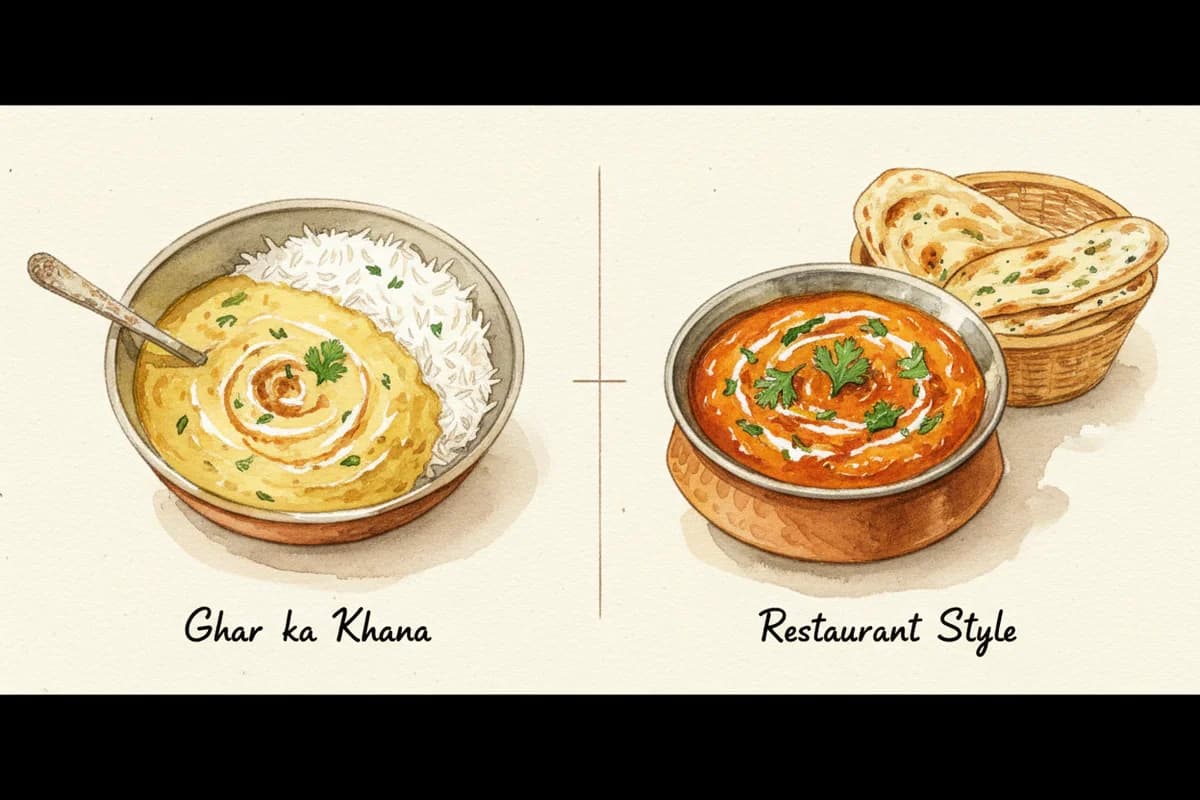
The gap between home cooking and restaurant cooking in Indian cuisine is enormous, probably larger than in any other cuisine:
- Restaurant dal makhani: May use 100 to 200 grams of butter and cream per batch. Per serving: 25 to 40 grams of fat.
- Home dal makhani: Uses 1 to 2 tablespoons of ghee or butter for the entire pot. Per serving: 7 to 10 grams of fat.
- Restaurant butter chicken: Swimming in butter and cream. Per serving: 30 to 50 grams of fat.
- Home-style chicken curry: Uses 1 to 2 tablespoons of oil for the masala base. Per serving: 12 to 15 grams of fat (including fat from the chicken itself).
The Visual Factor
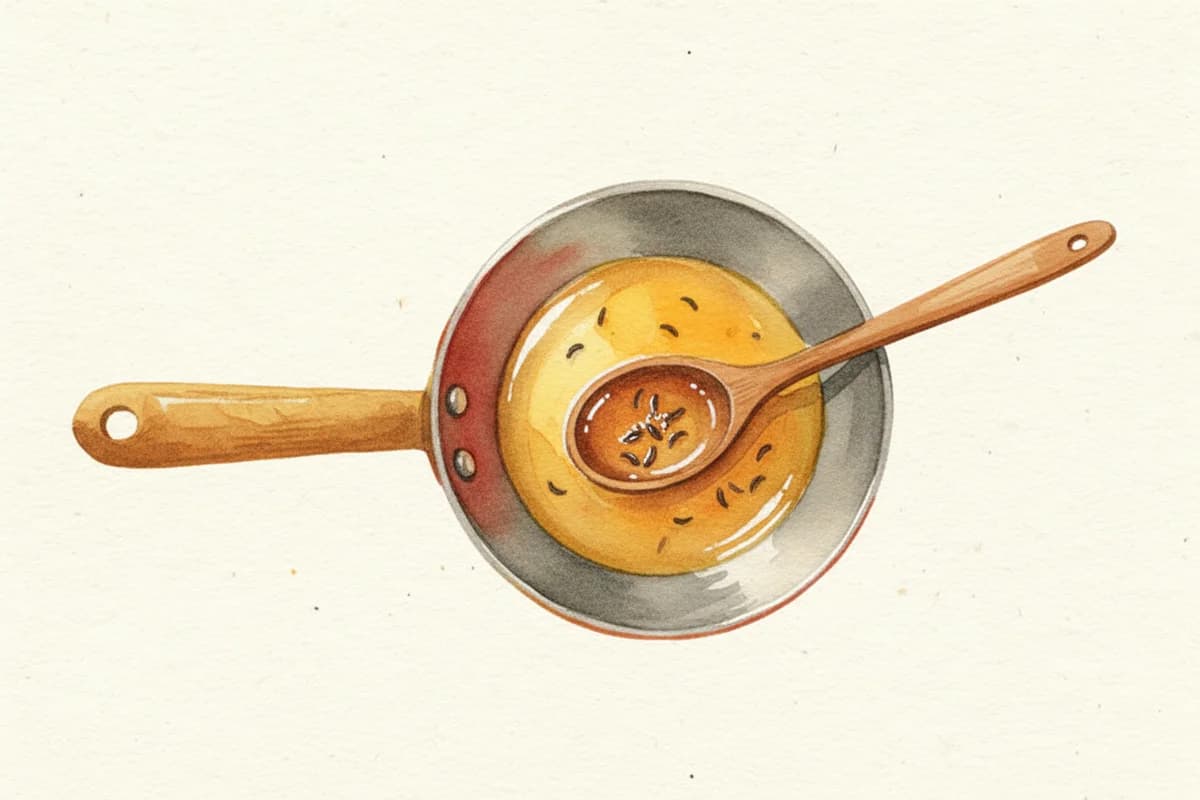
Indian food looks oily. A well-tempered tadka glistens with a thin layer of seasoned fat on top of a dal. A proper curry has a slick of oil separating from the masala, which is actually a sign of correct cooking technique.
But that visual impression is misleading. A tablespoon of oil spread across 4 servings of dal creates a visible sheen on each serving, even though each person is consuming only about a teaspoon of fat from the oil. Meanwhile, a croissant contains 12 grams of fat that is completely invisible because it is baked into the dough.
We judge Indian food as oily because we can see the fat. We do not judge Western food the same way because the fat is hidden in dough, cheese, dressings, and sauces.
Colonial and Cultural Bias
There is a historical dimension to this myth that is worth acknowledging. British colonial narratives frequently characterized Indian food as heavy, greasy, and inferior. These attitudes were not based on nutritional analysis. They were cultural judgments dressed up as health advice. Some of that framing persists in how Indian food is discussed globally.
What the Nutrition Science Says About Fat
Fat Is Not the Enemy
The low-fat diet movement of the 1980s and 1990s told us that dietary fat was the primary driver of obesity and heart disease. That advice has been substantially revised.
The landmark PREDIMED trial, published in the New England Journal of Medicine, found that a Mediterranean diet supplemented with extra-virgin olive oil (which means more fat) actually reduced cardiovascular events by 30 percent compared to a low-fat control diet [3]. The type of fat matters more than the total amount.
The Real Culprits
The American Heart Association's 2017 advisory on dietary fats identified the following hierarchy [2]:
- Trans fats (partially hydrogenated oils, vanaspati) are clearly harmful and should be eliminated.
- Excessive saturated fat may raise LDL cholesterol in some individuals, though the relationship with heart disease outcomes is debated.
- Monounsaturated and polyunsaturated fats (found in olive oil, mustard oil, and most cooking oils) are associated with improved cardiovascular outcomes.
The Tadka: A Fat-Efficient Cooking Method
The Indian tadka (tempering) is actually one of the most fat-efficient cooking techniques in the world. Here is why:
A tadka uses 1 to 2 tablespoons of oil or ghee to temper whole spices (cumin, mustard seeds, curry leaves, dried chilies). This flavored fat is then poured over an entire pot of dal, sambar, or vegetables serving 4 to 6 people.
The fat is not just adding calories. It is serving multiple functions:
- Flavor extraction. Many spice compounds are fat-soluble. The tadka extracts and distributes these flavors throughout the dish.
- Nutrient absorption. As we discuss in our black pepper and bioavailability article, fat improves the absorption of curcumin, beta-carotene, and other fat-soluble nutrients.
- Satiety. A small amount of fat in a meal dramatically increases satiety, meaning you eat less overall.
The Real Fat Problem in Modern Indian Diets
If home cooking is not the problem, what is? The genuine fat-related concerns in modern Indian diets are:
Vanaspati and Trans Fats
Vanaspati (partially hydrogenated vegetable fat) is genuinely harmful. It was introduced as a cheap substitute for ghee and is still used extensively in commercial food preparation, street food, and packaged snacks. Trans fats from vanaspati are strongly associated with cardiovascular disease and should be avoided.
Deep-Fried Snacks as Daily Food
Traditional Indian cooking includes deep-fried items like pakoras, puris, and samosas. In a traditional context, these were occasional foods, made for festivals, guests, or special days. When deep-fried snacks become daily eating through street food culture or packaged snacks, fat intake increases substantially.
Restaurant and Takeout Frequency
As more Indian families eat out or order delivery, the restaurant fat premium described above becomes a regular part of the diet rather than an occasional treat.
Excessive Oil in Actual Cooking
Some home cooks do use more oil than necessary, often because they were taught to cook that way or because they equate more oil with better flavor. The good news is that most Indian dishes taste just as good with 30 to 50 percent less oil than many recipes specify.
What This Means for Your Kitchen
- Measure your oil. Use a tablespoon to add oil to your pan instead of pouring from the bottle. You will likely find you need less than you think.
- A tadka needs 1 tablespoon, not 3. One tablespoon is sufficient to temper spices for a pot serving 4.
- Do not fear the fat you can see. The visible oil on your dal represents a small amount of fat per serving. The invisible fat in processed foods is the greater concern.
- Choose your fats wisely. Mustard oil, ghee, coconut oil, and cold-pressed oils are all reasonable choices for Indian cooking. Avoid vanaspati and trans fats entirely.
- Cook at home more. This single change will reduce your fat intake from Indian food more than any other adjustment.
- Use traditional techniques. Pressure cooking dal, dry-roasting spices, steaming (like idli), and using a tadka are all inherently fat-efficient techniques.
The Bottom Line
The "too much oil" myth about Indian food confuses restaurant cooking with home cooking and visible fat with total fat. When you actually measure the fat in a typical home-cooked Indian meal, it contains less than many foods that are perceived as healthy alternatives.
Home-cooked Indian food, prepared with traditional techniques and moderate amounts of quality cooking fat, is not a high-fat cuisine. It is a fat-efficient cuisine that uses small amounts of fat strategically to maximize flavor, nutrient absorption, and satiety.
The advice is not to eliminate fat from Indian cooking. The advice is to cook at home, measure your oil, and trust the traditional techniques that have sustained one of the world's largest populations for centuries.
Sources and References
- [1] Mattson FH, Grundy SM. “Comparison of effects of dietary saturated, monounsaturated, and polyunsaturated fatty acids on plasma lipids and lipoproteins in man.” Journal of Lipid Research, 1985. View source
- [2] Sacks FM, Lichtenstein AH, Wu JHY, Appel LJ, Creager MA, Kris-Etherton PM, Miller M, Rimm EB, Rudel LL, Robinson JG, Stone NJ, Van Horn LV. “Dietary Fats and Cardiovascular Disease: A Presidential Advisory From the American Heart Association.” Circulation, 2017. View source
- [3] Estruch R, Ros E, Salas-Salvado J, et al.. “Primary Prevention of Cardiovascular Disease with a Mediterranean Diet Supplemented with Extra-Virgin Olive Oil or Nuts.” New England Journal of Medicine, 2018. View source
- [4] National Institute of Nutrition, Indian Council of Medical Research. “Dietary Guidelines for Indians.” National Institute of Nutrition, 2011. View source
Medical Disclaimer
This content is for educational purposes only. It is not medical advice, diagnosis, or treatment. Consult your doctor or registered dietitian before making dietary changes, especially if you have a medical condition or are taking medication.
Related Recipes
More on Nutrition
Get Weekly Nutrition Insights
Evidence-based articles on Indian food and health, delivered to your inbox. No spam, no fads, just science.