Is Indian Food Unhealthy? What the Data Actually Shows
Medical Disclaimer
This content is for educational purposes only. It is not medical advice, diagnosis, or treatment. Consult your doctor or registered dietitian before making dietary changes, especially if you have a medical condition or are taking medication.
In This Article
The Myth That Will Not Die
"Indian food is so heavy." "It is full of oil." "All that ghee cannot be good for you." "No wonder Indians have so much diabetes."
You have heard these claims. You may have even believed them. They are repeated by well-meaning friends, health influencers, and sometimes even doctors who conflate restaurant Indian food with the food Indian families actually cook at home.
Here is the problem: when you look at actual data on traditional Indian home cooking, the narrative falls apart.
The Critical Distinction: Restaurant vs. Home
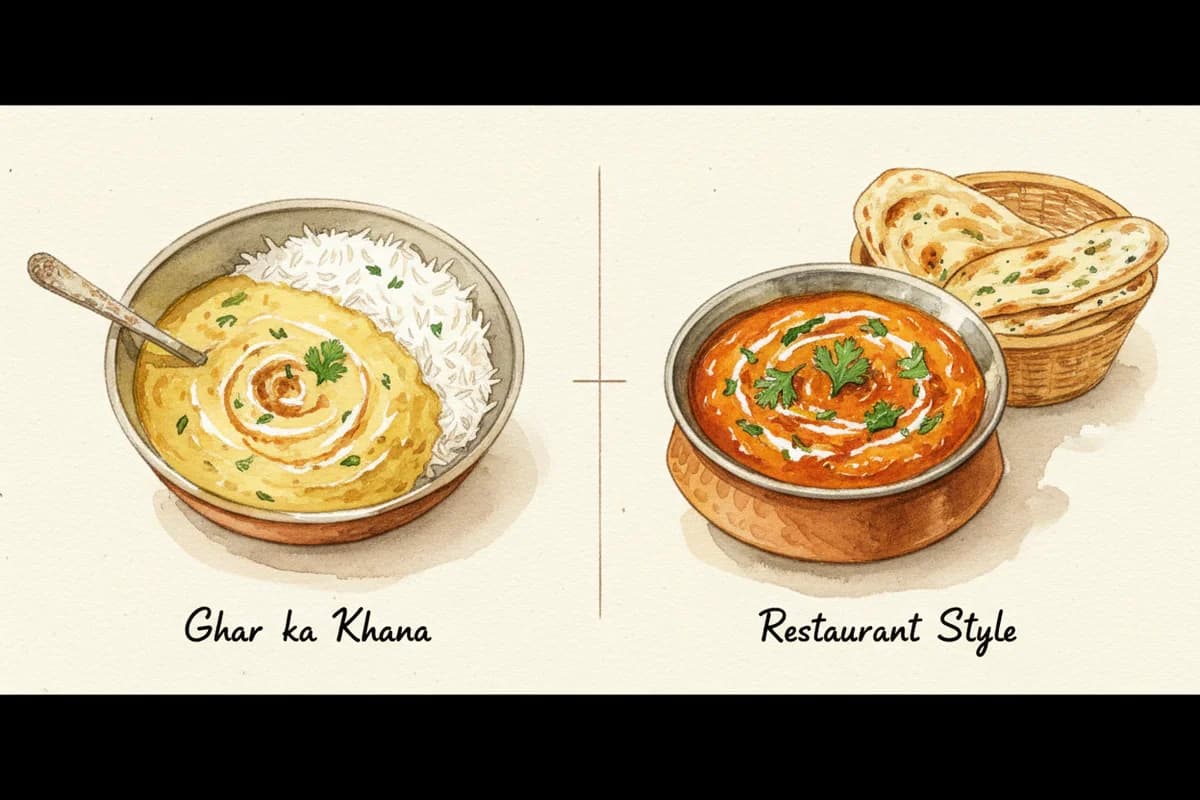
The single most important fact in this entire discussion is one that most people overlook: restaurant Indian food and home-cooked Indian food are two entirely different nutritional categories.
A restaurant butter chicken might contain 200 milliliters of cream and 100 grams of butter per serving. A home-cooked version uses a fraction of that. A restaurant naan might be slathered with butter and refined flour. A home roti is whole wheat with no added fat.
A 2016 systematic review in the British Journal of Nutrition found that traditional Indian dietary patterns, characterized by whole grains, lentils, vegetables, and moderate dairy, were associated with lower risk of chronic disease compared to modern, Westernized Indian diets [2]. The problem is not traditional Indian food. The problem is what Indian food has become in restaurants and processed food markets.
What Traditional Indian Home Cooking Actually Looks Like
Let us examine a typical home-cooked Indian meal:
A weeknight dinner in a middle-class Indian home:- 2 whole wheat rotis (approximately 200 calories, 8 grams protein, 6 grams fiber)
- 1 bowl of dal (approximately 180 calories, 12 grams protein, 8 grams fiber)
- 1 serving of sabzi / vegetable dish (approximately 100 to 150 calories)
- A small bowl of dahi (yogurt) or raita (approximately 60 calories, 5 grams protein)
Compare this to a standard American dinner:
- A hamburger with bun (approximately 500 to 700 calories)
- French fries (approximately 300 to 400 calories)
- A soda (approximately 150 calories)
The Indian meal is lower in calories, higher in fiber, higher in protein diversity, and dramatically higher in micronutrient density. The idea that Indian food is inherently unhealthy does not survive contact with actual numbers.
The Nutrition Transition: What Actually Went Wrong
If traditional Indian food is nutritionally sound, why has India seen such a dramatic increase in diabetes, heart disease, and obesity?
The answer is not that Indian food is unhealthy. The answer is that India's food system has changed dramatically over the past 50 years.
The Shift Away From Traditional Diets
A landmark study by Misra and colleagues in the Journal of Diabetes documented India's nutrition transition [1]. The key changes include:
- Increased consumption of refined grains. White rice and maida (refined flour) have replaced whole grains like bajra, jowar, ragi, and whole wheat in many households.
- Increased consumption of sugar and sweetened beverages. Traditional Indian diets included relatively little added sugar. Modern Indian diets include significant amounts.
- Increased consumption of refined vegetable oils. Total fat intake has not necessarily increased, but the type of fat has shifted from traditional fats (ghee, mustard oil, coconut oil) to highly processed, industrially refined oils.
- Decreased consumption of pulses. Per capita pulse consumption in India has declined significantly over the past four decades, despite pulses being the primary protein source in traditional diets.
- Decreased physical activity. This is not a food issue, but it compounds the dietary changes.
The Urbanization Effect
Popkin's landmark paper on the global nutrition transition found that urbanization drives dietary shifts away from traditional patterns toward processed, calorie-dense foods across all developing countries, not just India [4]. The problem is not unique to Indian cuisine. It is a global pattern that affects every traditional food culture.
The Myth vs. The Data
Myth: "Indian food has too much oil"
The data: A typical home-cooked Indian vegetable dish (sabzi) uses 1 to 2 tablespoons of oil for an entire family preparation serving 4 people. That is approximately 1 to 2 teaspoons of fat per person per dish. Many Indian preparations, like dal, use even less.The perception of excessive oil comes from restaurant cooking, where liberal use of fat improves flavor and appearance at the cost of health. Home cooking is a different story entirely. See our detailed analysis in The "Too Much Oil" Myth.
Myth: "All that carbohydrate from rice and roti makes you fat"
The data: Populations in Japan, South Korea, and Southeast Asia consume equal or greater amounts of rice than Indians and have lower obesity rates. The relationship between carbohydrate intake and weight gain depends heavily on the type of carbohydrate (whole vs. refined), the overall caloric context, and physical activity levels. See our detailed analysis in Is Rice Fattening?.Myth: "Indian food lacks protein"
The data: A traditional Indian diet that includes daily dal, weekly paneer or dahi, and occasional eggs or meat can easily meet protein requirements. One cup of cooked lentils provides 18 grams of protein. A bowl of dahi adds another 10 to 15 grams. Two rotis contribute 8 grams. A traditional vegetarian Indian diet provides 50 to 65 grams of protein daily, which meets the RDA for most adults.The protein quality concern (that plant proteins are "incomplete") has been addressed by modern research showing that daily variety, not meal-by-meal combining, is what matters.
Myth: "Ghee and coconut oil are killing Indians"
The data: Research on ghee and coconut oil has become far more nuanced in recent years. Multiple studies suggest that moderate consumption of traditional fats in the context of an otherwise healthy diet is not associated with increased cardiovascular risk. The rise in heart disease in India correlates more strongly with increased consumption of refined carbohydrates, trans fats from vanaspati, and decreased physical activity than with traditional fat consumption.Myth: "Spices are just flavoring with no nutritional value"
The data: Indian spices are among the most bioactive food compounds studied. Turmeric has demonstrated anti-inflammatory properties. Black pepper enhances nutrient absorption by up to 2,000 percent. Fenugreek may help regulate blood sugar. Cumin, coriander, and ginger all have documented biological effects beyond flavoring.What the Blue Zones Can Teach Us
The world's Blue Zones, regions where people live the longest, healthiest lives, share several dietary patterns that closely mirror traditional Indian home cooking:
- Plant-forward diets with meat as an occasional component, not the centerpiece
- Legumes as a daily staple (beans, lentils, chickpeas)
- Whole grains rather than refined grains
- Moderate use of healthy fats (olive oil in Sardinia, coconut in Okinawa, ghee in traditional India)
- Herbs and spices used abundantly
- Fermented foods consumed regularly (yogurt, pickles)
What Actually Makes Indian Diets Unhealthy (When They Are)
The problem is not Indian food. The problem is specific modern changes:
- Excessive refined carbohydrates. Too much white rice, maida-based breads and snacks, and sugary drinks.
- Portion distortion. Restaurant-sized servings and unlimited refills that do not reflect traditional eating patterns.
- Processed snacks replacing traditional snacks. Packaged chips and biscuits replacing roasted chana, makhana, or fresh fruit.
- Trans fats from vanaspati and partially hydrogenated oils. These are genuinely harmful and should be avoided.
- Sedentary lifestyles. The traditional Indian diet was calibrated for much higher activity levels than modern office workers maintain.
- Reduced dietary diversity. Eating the same 3 to 4 dishes on rotation instead of the seasonal variety that characterized traditional cooking.
What This Means for Your Kitchen
If you want to eat Indian food that is genuinely healthy, the answer is not to abandon Indian cuisine. It is to cook more like your grandmother did:
- Cook at home. Home-cooked Indian food is dramatically healthier than restaurant food. There is no shortcut around this.
- Eat dal daily. It is high in protein, high in fiber, low in fat, and cheap. There is no better staple food.
- Use whole grains. Whole wheat roti, brown rice (or hand-pounded rice), bajra, jowar, and ragi are all traditional Indian grains that are far more nutritious than refined alternatives.
- Eat seasonal vegetables. A traditional Indian household cooked 20 to 30 different vegetables throughout the year. Try to maintain that diversity.
- Use traditional fats in moderation. A teaspoon of ghee or mustard oil per person is fine. A swimming pool of it is not.
- Include fermented foods. Daily dahi, occasional pickles, and fermented batters (idli, dosa) support gut health.
- Add spices generously. Turmeric with black pepper, cumin, coriander, fenugreek, and ginger are all nutritionally active.
The Bottom Line
The claim that Indian food is unhealthy is based on a fundamental misunderstanding. It confuses restaurant food with home cooking, modern processed diets with traditional patterns, and correlation with causation.
When you look at the actual data, traditional Indian home cooking is one of the most nutritionally sophisticated food systems in the world. It is plant-forward, legume-rich, spice-dense, and fermented. It checks every box that modern nutrition science associates with longevity and health.
The answer to "is Indian food unhealthy?" is no. The answer to "has India's food system changed in unhealthy ways?" is yes. Those are two very different questions, and confusing them does a disservice to one of the world's great culinary traditions.
Sources and References
- [1] Misra A, Singhal N, Sivakumar B, Bhagat N, Jaiswal A, Khurana L. “Nutrition transition in India: Secular trends in dietary intake and their relationship to diet-related non-communicable diseases.” Journal of Diabetes, 2011. View source
- [2] Green R, Milner J, Joy EJ, Agrawal S, Dangour AD. “Dietary patterns in India: a systematic review.” British Journal of Nutrition, 2016. View source
- [3] Radhika G, Sathya RM, Ganesan A, Saroja R, Vijayalakshmi P, Sudha V, Mohan V. “Dietary profile of urban adult population in South India in the context of chronic disease epidemiology (CURES-68).” Public Health Nutrition, 2011. View source
- [4] Popkin BM, Adair LS, Ng SW. “Global nutrition transition and the pandemic of obesity in developing countries.” Nutrition Reviews, 2012. View source
- [5] Shetty PS. “Nutrition transition in India.” Public Health Nutrition, 2002. View source
Medical Disclaimer
This content is for educational purposes only. It is not medical advice, diagnosis, or treatment. Consult your doctor or registered dietitian before making dietary changes, especially if you have a medical condition or are taking medication.
Related Recipes
More on Nutrition
Get Weekly Nutrition Insights
Evidence-based articles on Indian food and health, delivered to your inbox. No spam, no fads, just science.