The Quick Comparison
| Feature | Stovetop Pressure Cooker | Instant Pot |
|---|---|---|
| Pressure | ~15 PSI (higher) | ~11.6 PSI (lower) |
| Dal cook time | 3-4 whistles (~8-12 min) | 15-25 min (plus pressurize/release) |
| Total time | Faster | Slower (due to pressurize time) |
| Hands-on | Requires monitoring | Set and forget |
| Sauteing | Excellent (direct flame) | Adequate (electric element) |
| Tadka in pot | Yes, directly | Possible but less control |
| Price | $25-60 | $80-150 |
| Counter space | Stored like any pot | Large, needs permanent space |
| Learning curve | Moderate (whistle counting) | Low (digital presets) |
| Versatility | Pressure cooking only | Slow cook, yogurt, rice, etc. |
| Durability | Decades (simple mechanics) | 3-7 years (electronic components) |
The Indian Kitchen Context
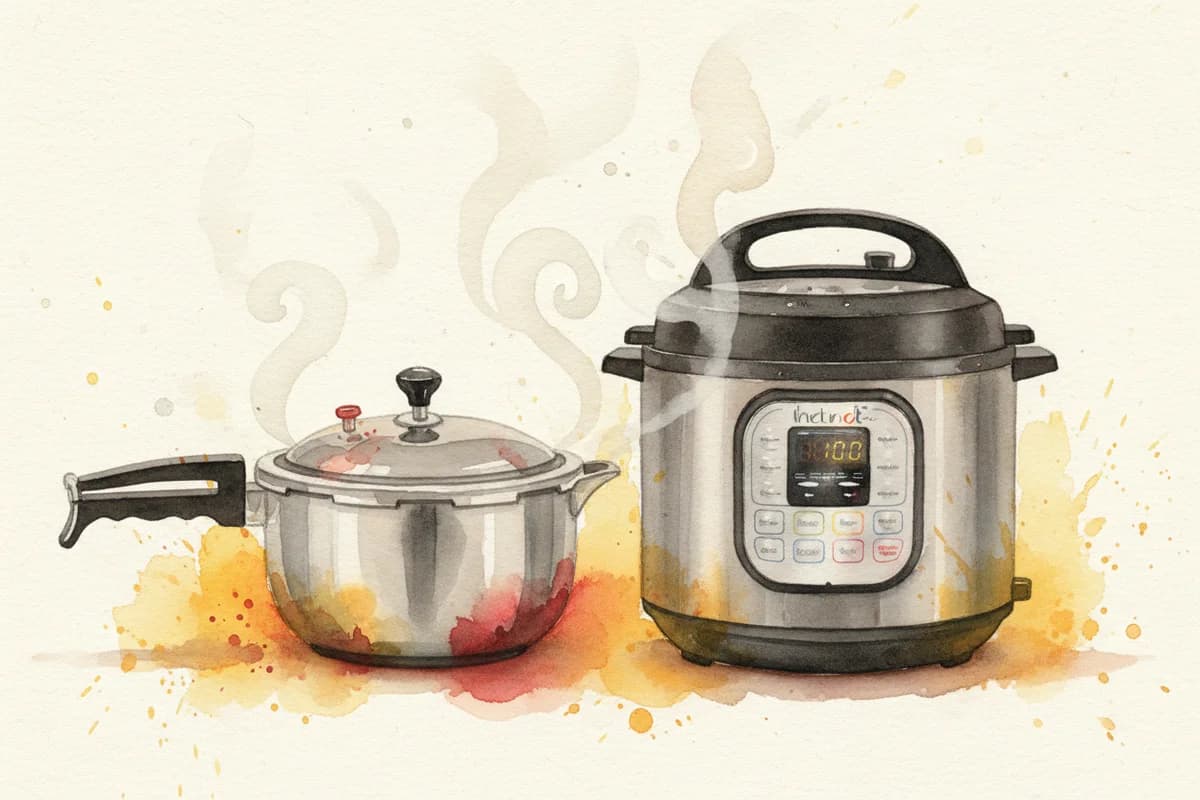
In India, the pressure cooker is not an appliance. It is infrastructure. The sound of a pressure cooker whistle in the morning means dal is being made. That rhythmic "pssshhh-WHISTLE" is the soundtrack of Indian cooking.
The Hawkins and Prestige brands have been in Indian kitchens for 50+ years. They are inexpensive, nearly indestructible, and every Indian cook understands how to use one intuitively. "Give it 3 whistles" is a cooking instruction as natural as "simmer for 10 minutes."
The Instant Pot arrived as a modern alternative, particularly popular with the Indian diaspora. It promised the same results with less monitoring and more convenience. The question is: does it deliver?
Where the Stovetop Pressure Cooker Wins
Speed
This surprises most people, but the stovetop cooker is genuinely faster. It reaches higher pressure (15 PSI vs. 11.6 PSI) and heats up faster on a gas flame than the Instant Pot's electric element.
A typical dal in a stovetop cooker: heat up (3 minutes) + cook (8 to 10 minutes) + natural release (5 minutes) = 16 to 18 minutes total.
The same dal in an Instant Pot: pressurize (10 to 15 minutes) + cook (8 to 10 minutes) + natural release (10 to 15 minutes) = 28 to 40 minutes total.
The Instant Pot's "15 minute dal" is a bit misleading because it does not include pressurization and release time. The stovetop cooker, despite requiring more attention, gets food on the table faster.
Tadka and Sauteing
Indian cooking often requires sauteing onions, ginger-garlic, and spices before adding lentils or meat. On a stovetop cooker, you can do this directly in the cooker on your gas flame, getting excellent caramelization and heat control.
The Instant Pot's saute function works, but it is an electric hot plate. It heats unevenly, takes longer to reach high temperatures, and does not provide the same browning quality. Many experienced Indian cooks find themselves doing the tadka in a separate pan anyway, defeating the one-pot purpose.
Cost and Durability
A Hawkins or Prestige pressure cooker costs $25 to $60 and, with occasional gasket replacement, lasts literally decades. Your grandmother's pressure cooker probably still works.
An Instant Pot costs $80 to $150, has electronic components that can fail, and typically lasts 3 to 7 years before something gives out. The replacement gaskets, inner pots, and accessories add up.
Simplicity
A stovetop pressure cooker has no buttons, no programs, and no learning curve beyond "count the whistles." There is an elegance to this simplicity. It cannot malfunction in ways you do not understand, and it does not need a firmware update.
Where the Instant Pot Wins
Unattended Cooking
This is the Instant Pot's genuine advantage. You press a button and walk away. No monitoring, no whistle counting, no adjusting flame levels. For busy households, parents managing children, or anyone who cannot stand at the stove, this matters.
Consistency
The digital controls and preset programs produce the same results every time. A stovetop cooker requires you to learn your specific stove's heat output and adjust accordingly. The Instant Pot removes that variable.
Multi-Function
The Instant Pot slow cooks, makes yogurt (dahi), cooks rice, and steams. If you are short on kitchen space and cannot have multiple appliances, the Instant Pot consolidates several tools into one.
The yogurt function is particularly useful for Indian cooking. Homemade dahi in the Instant Pot is genuinely effortless and produces excellent results.
Safety
Modern stovetop cookers are safe when used correctly, but they do require attention. Forgetting a pressure cooker on the stove can be dangerous. The Instant Pot has multiple electronic safety mechanisms and automatically turns off when cooking is complete.
Diaspora Kitchen Advantage
For Indians living abroad, the Instant Pot is often more practical:
- Many Western kitchens have electric stoves, which work poorly with stovetop pressure cookers
- The Instant Pot is widely available in Western retail stores
- It is less intimidating for non-Indian family members who might need to use it
The Verdict for Specific Tasks
Dal
Stovetop wins on speed and the ability to do tadka in the same pot. Instant Pot wins on convenience if you do not mind the extra 10 to 15 minutes.Rice
Instant Pot wins. The rice function is genuinely excellent, producing consistent results with the right water ratio. Stovetop pressure cooker rice requires more finesse to avoid overcooking.Meat Curries
Roughly equal. Both produce fall-apart tender meat. The stovetop is faster; the Instant Pot requires less monitoring.Rajma / Chole (Dried Beans)
Stovetop wins slightly on speed. Chickpeas and kidney beans cook faster at 15 PSI. The Instant Pot works fine but takes longer.Dahi (Yogurt)
Instant Pot wins. The yogurt function maintains the exact temperature needed for fermentation. Making dahi in a stovetop cooker is not a standard use case.Kheer / Payasam
Stovetop wins. Slow reduction of milk requires visual monitoring and stirring, which you cannot do in a sealed Instant Pot.The Recommendation
If you cook Indian food daily and are comfortable at the stove: Get a stovetop pressure cooker (3-liter for dal, 5-liter for larger batches and meat). It is faster, cheaper, better for tadka, and will outlast you. If you want convenience, have an electric stove, or are new to Indian cooking: Get an Instant Pot (6-quart is the most versatile size). The set-and-forget convenience is real, and the multi-function capability adds value. If you can have both: A stovetop cooker for quick daily dal and a pot for rice, and the Instant Pot for weekend slow cooks, yogurt making, and hands-off cooking. They complement each other well.The Bottom Line
The Indian stovetop pressure cooker is faster, cheaper, and produces better results for the specific cooking tasks that define Indian cuisine. The Instant Pot is more convenient, more versatile, and more forgiving. Neither is objectively "better." The right choice depends on how you cook, where you live, and what you value most.
What both tools share is the ability to turn dried lentils into a bowl of creamy dal in under 30 minutes. And that is really what matters.