The Short Answer
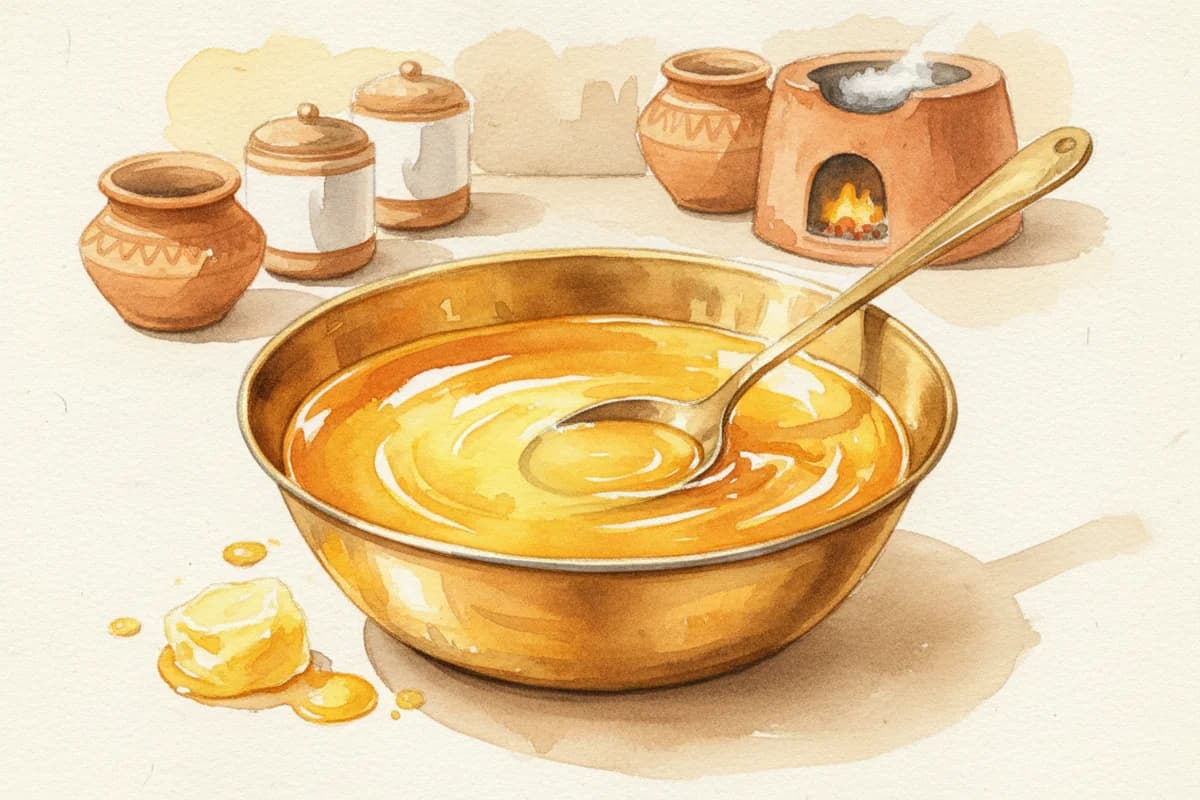
Ghee is clarified butter. You heat butter until the water evaporates and the milk solids separate, strain out the solids, and what remains is a golden, nutty-flavored pure butterfat that can withstand high cooking temperatures and lasts for months without refrigeration.
That is the technical definition. But in India, ghee is much more than a cooking fat. It is the flavor foundation of an entire cuisine, a sacred offering in religious ceremonies, and a food that grandmothers have prescribed for everything from dry skin to exam-day brain power.
How Ghee Is Made
Traditional ghee-making follows a process that has not changed in thousands of years:
- Start with butter. Traditionally, butter is churned from dahi (yogurt), not from fresh cream. This cultured butter gives ghee a slightly more complex flavor.
- Simmer slowly. The butter melts and begins to bubble as the water content evaporates.
- Watch the milk solids. White milk solids sink to the bottom and slowly turn golden brown. This browning is what gives ghee its distinctive nutty, caramel-like aroma.
- Strain. Once the bubbling stops (all water is gone) and the solids are golden, the liquid is strained through cheesecloth.
- Cool. The result is pure golden fat that solidifies at room temperature to a creamy, granular texture.
How Ghee Tastes
If you have never tasted ghee, imagine butter with the volume turned up. The nutty, caramelized flavor of the browned milk solids infuses the fat during cooking, creating something richer and more complex than plain butter.
Good ghee has a warm, slightly sweet aroma. It melts instantly on hot food, releasing that fragrance. A teaspoon of ghee on hot rice or dal transforms the dish in a way that no other fat can replicate.
Why Indian Cooking Uses Ghee
High Smoke Point
Ghee's smoke point is approximately 250 degrees Celsius (482 degrees Fahrenheit), one of the highest among common cooking fats. This makes it ideal for the high-heat techniques central to Indian cooking: tempering whole spices in hot fat (tadka), searing meats, and deep frying.
Many vegetable oils begin to break down and produce harmful compounds at the temperatures Indian cooking requires. Ghee remains stable.
Flavor Carrier
Indian spices are largely fat-soluble. When you bloom cumin seeds, mustard seeds, or curry leaves in hot ghee, the fat extracts their aromatic compounds and distributes them throughout the dish. This is why the tadka (spice tempering) is the flavor engine of Indian cooking, and ghee is the fuel.
Shelf Stability
Because the water and milk solids have been removed, ghee does not spoil quickly. In a cool, dark pantry, it lasts 3 to 6 months. In India's hot climate, this was historically essential. Ghee allowed families to preserve the nutritional value of milk in a shelf-stable form.
Ghee vs. Butter
The key differences:
| Property | Ghee | Butter |
|---|---|---|
| Smoke point | 250°C (482°F) | 175°C (347°F) |
| Milk solids | Removed | Present |
| Lactose | None | Small amount |
| Casein | None | Present |
| Shelf life | 3-6 months (no refrigeration) | 1-2 months (refrigerated) |
| Flavor | Nutty, caramelized | Creamy, mild |
For a deeper comparison, see our ghee vs. butter analysis.
How to Use Ghee
For tadka (tempering). Heat 1 to 2 teaspoons of ghee, add whole spices (cumin, mustard seeds, dried chilies), and pour over dal, rice, or vegetables. This is the single most common use. See our complete guide to tempering spices. For roti and paratha. A light brush of ghee on a fresh-off-the-tawa roti is one of life's simple pleasures. For parathas, ghee is layered into the dough to create flaky layers. For rice. A teaspoon of ghee stirred into hot rice, or used to make jeera rice or pulao, adds richness that oil cannot match. For sweets. Halwa, ladoo, and many Indian desserts are made with ghee as the primary fat. The flavor is irreplaceable. For finishing. A small spoonful of ghee added to a finished dal makhani or biryani just before serving adds a final layer of aroma and richness.How to Buy Ghee
Grocery store ghee from Indian brands (Amul, Patanjali, Nanak) is widely available and perfectly good for everyday cooking. Grass-fed ghee from brands like Fourth and Heart, Ancient Organics, or Organic Valley contains more omega-3 fatty acids and conjugated linoleic acid. It is pricier but nutritionally superior. See our article on ghee and health for the research. Homemade ghee is easy to make and gives you control over quality. Start with unsalted butter (preferably from grass-fed cows), simmer until golden, strain, and store.How to Store Ghee
- Keep in an airtight glass jar (not plastic, which can absorb odors)
- Store in a cool, dark place
- Always use a clean, dry spoon (moisture is ghee's enemy)
- No refrigeration needed unless your kitchen is very hot
- Ghee solidifies below about 25°C and liquefies above it. Both states are normal.
The Bottom Line
Ghee is the flavor backbone of Indian cooking. It is not complicated, not exotic, and not unhealthy in the moderate amounts that home cooking uses. It is simply butter, perfected through a process that removes everything that makes butter perishable and fragile, leaving behind pure, golden, endlessly useful fat.
If you are building an Indian pantry, ghee is the first thing to buy. If you already cook Indian food, you probably already know this. And if you are new to Indian cooking, that first spoonful of ghee melting into a pot of hot dal is going to change how you think about fat in the kitchen.