Why This Matters More Than Any Spice
If someone asked what single ingredient contributes more to the flavor of Indian food than any spice, the answer would be onions. Specifically, deeply caramelized, golden-brown onions that have been cooked slowly until their natural sugars transform into complex, savory-sweet flavor compounds.
This process, called "pyaaz bhuno" (onion cooking) in Hindi, is the base of virtually every North Indian curry, many Mughlai dishes, biryani, and countless other preparations. Get it right, and everything you build on top of it tastes better. Rush it, and the entire dish suffers.
The Science of Onion Caramelization
Raw onions contain sugars (primarily glucose, fructose, and sucrose) trapped inside cell walls. When you cook onions, three things happen:
- Water evaporates. Onions are about 89 percent water. As the water leaves, the sugars and amino acids concentrate.
- Maillard reaction. At temperatures above 130°C (266°F), sugars and amino acids react to create hundreds of new flavor compounds. These are the complex, savory-sweet notes you associate with cooked onions. This is the same reaction that browns bread and sears meat.
- Caramelization. At higher temperatures, the sugars themselves break down and rearrange, creating deep golden-brown color and nutty, butterscotch-like flavors.
The Full Method (Traditional)
Time: 15 to 25 minutes Onions: 2 medium onions, thinly sliced or finely diced (about 2 cups) Fat: 2 tablespoons oil or gheeStep 1: Prep the Onions
Thin, uniform slicing is important. Uneven pieces cook at different rates, giving you some burnt bits and some raw bits in the same pan. Use a sharp knife and cut with the grain (from root to tip) for slices, or against the grain for dice.Step 2: Heat the Fat
Heat oil or ghee over medium-high heat in a heavy-bottomed pan. A wide, shallow pan works better than a deep pot because more surface area means more evaporation and faster browning.
Step 3: Add Onions and Salt
Add the sliced onions and a pinch of salt. The salt draws out moisture, which accelerates the initial softening phase. Stir to coat in the fat.
Step 4: The Initial Cook (5-7 minutes)
Cook on medium-high heat, stirring occasionally. The onions will first release water and steam. They will soften and become translucent. This is not caramelization yet. This is just the water leaving.
Step 5: The Browning Phase (8-15 minutes)
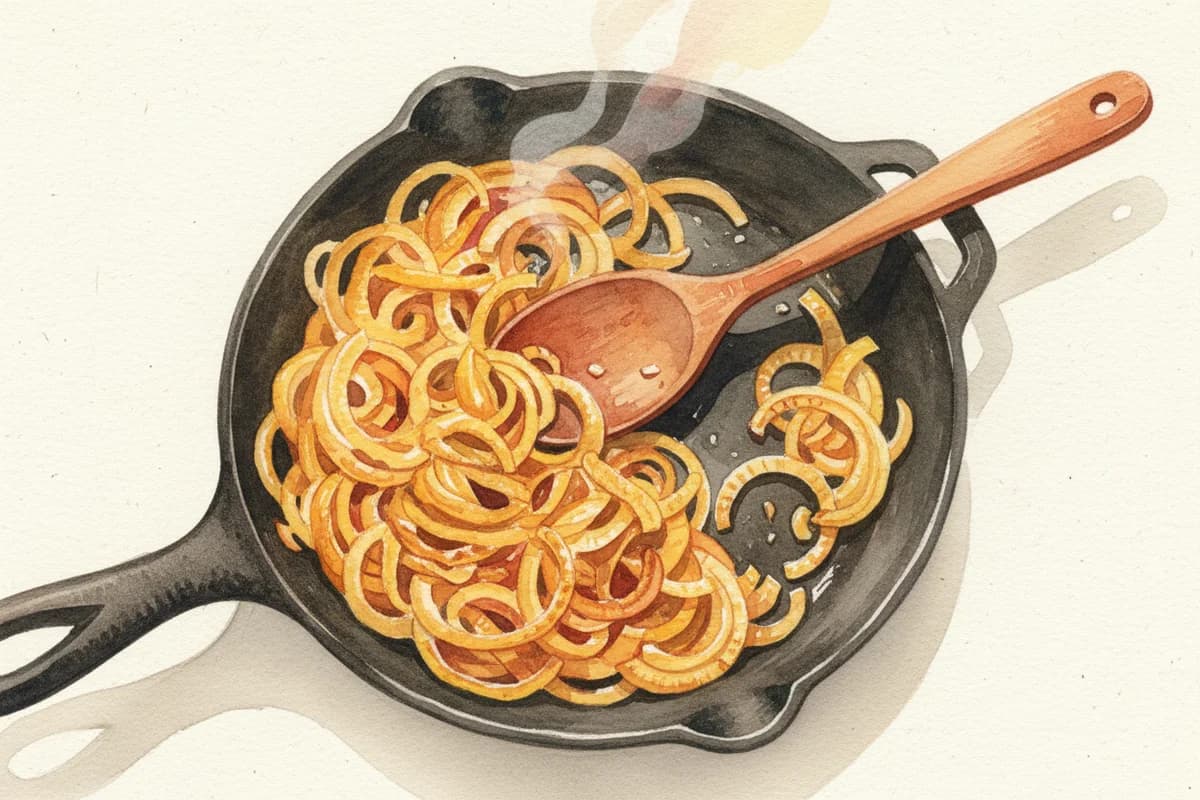
Once the water has evaporated, the onions begin to color. Reduce heat to medium. Stir more frequently now, scraping the bottom of the pan. The sugars will begin to stick to the pan surface (this is fond, the concentrated flavor) and then dissolve back as you stir.
Color stages:- Light gold: Good for lighter curries, biryani base layers
- Medium golden brown: Standard for most curries (this is what most recipes mean by "golden onions")
- Deep brown, almost mahogany: For birista (fried onion garnish for biryani), kosha mangsho, dark Mughlai curries
Step 6: Add a Splash of Water (Optional)
If the onions are browning too fast or sticking too aggressively, add 1 to 2 tablespoons of water. This dissolves the fond and redistributes the caramelized sugars back onto the onions. This technique, called deglazing, can be repeated 2 to 3 times to develop deeper color without burning.
The Quick Method (When You Are in a Hurry)
The Baking Soda Trick
Add a tiny pinch of baking soda (1/8 teaspoon for 2 onions) when you add the onions to the pan. Baking soda raises the pH, which accelerates the Maillard reaction. Onions that normally take 20 minutes will reach deep golden in 10 to 12 minutes.
Caution: Too much baking soda makes onions mushy and adds a soapy off-flavor. Use no more than 1/8 teaspoon. This is a legitimate technique used in restaurant kitchens, not a hack.The High-Heat Method
Use medium-high to high heat from the start and stir constantly. This is how dhaba cooks work. The trade-off is that you cannot leave the pan for even 30 seconds. One moment of inattention means burnt onions. This takes about 10 to 12 minutes but demands full attention.
The Microwave Head Start
Microwave sliced onions for 3 to 4 minutes before adding to the pan. This drives off much of the water, reducing stovetop time by about 5 minutes. The texture is slightly different but the flavor is good.
How Indian Cooking Uses Caramelized Onions
As a Curry Base
The most common use. Caramelized onions + ginger-garlic paste + tomatoes + ground spices = the base gravy (masala) for hundreds of Indian dishes. The quality of the caramelized onions determines the quality of the final curry.
As Birista (Crispy Fried Onions)
Thinly sliced onions deep-fried until dark brown and crispy. Used as a garnish and flavoring in biryani, some Mughlai curries, and as a topping for various dishes. Birista adds a sweet, crunchy, smoky element that elevates anything it touches.
As a Thickener
Pureed caramelized onions are used in Mughlai gravies and kormas to create a smooth, rich sauce base without dairy. The natural pectin in cooked onions provides body, and the caramelized sugars add depth.
In Specific Dishes
- Dal Makhani: Onion base for the masala
- Butter Chicken: Deeply browned onions create the dark, rich gravy
- Biryani: Both in the meat marinade and as birista garnish
- Rajma/Chole: The onion-tomato base defines the gravy
Common Mistakes
Not enough time. The most common error. Five minutes of cooking gives you softened onions, not caramelized ones. If your curries taste flat, you probably did not cook the onions long enough. Not enough fat. Onions need fat to caramelize evenly. Too little oil means some patches burn while others steam. Use a minimum of 1 tablespoon per onion. Overcrowding the pan. Too many onions in a small pan create steam rather than browning. Cook in batches if needed, or use a wider pan. Constant stirring. Counterintuitive, but do not stir constantly in the browning phase. Let the onions sit and make contact with the hot pan surface for 30 to 45 seconds between stirs. Contact time = browning time. Burning vs. caramelizing. Dark brown is good. Black is burnt. If you see black edges, your heat is too high. Reduce immediately.The Bottom Line
Caramelizing onions is the most time-intensive step in Indian cooking, and it is also the most important. Everything else, the spices, the protein, the simmering, builds on the flavor foundation that properly cooked onions provide.
There is no shortcut that fully replicates 20 minutes of patient onion cooking. The quick methods get you 80 percent of the way there, which is fine for weeknight cooking. But when you want the best results, give the onions the time they need.
The difference between a good Indian curry and a great one is almost always in the onions.