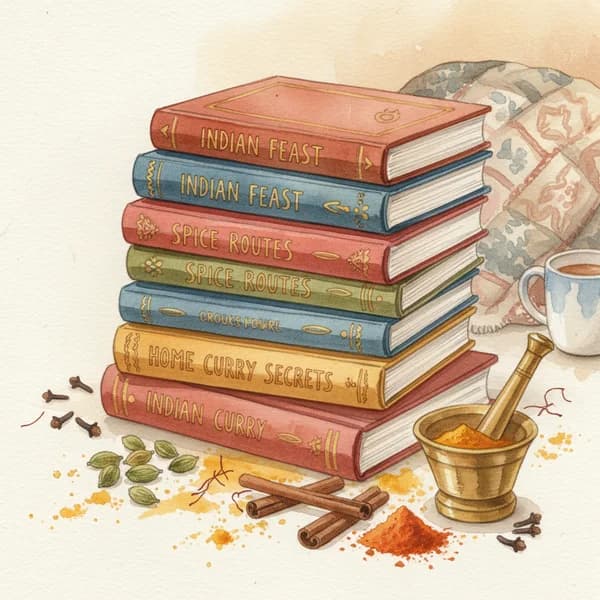
A good Indian cookbook does more than list ingredients and steps. It teaches you why you temper cumin seeds in hot oil before adding onions, how regional climates shaped entirely different cuisines across a single country, and when to trust your instincts over exact measurements. The 10 books below cover every level and interest, from total beginners to experienced cooks chasing restaurant-quality results.
1. An Invitation to Indian Cooking by Madhur Jaffrey
Best for: Absolute beginners who want to understand the fundamentalsPublished in 1973, this is the book that introduced Indian cooking to the English-speaking world. Jaffrey does not overwhelm you with hundreds of recipes. Instead, she walks you through roughly 100 dishes with the warmth and detail of a patient teacher explaining things at your kitchen counter.
What sets this book apart is the cultural context woven into every recipe. You learn not just how to make a dish but where it comes from and why it matters. The techniques Jaffrey teaches here, such as tempering spices and building layered flavors, form the foundation for everything else on this list.
Weakness: The ingredient sourcing advice is dated. Some items that were hard to find in 1973 are now available in most supermarkets. Quantities occasionally lean vague by modern standards. Find it on Amazon2. Indian Cooking by Madhur Jaffrey
Best for: Home cooks who want a single, comprehensive reference bookIf the first Jaffrey book is an introduction, this is the encyclopedia. With over 600 recipes spanning every region of India, this is the book you reach for when you want to cook something specific and need a reliable version. North Indian curries, South Indian rice dishes, Bengali fish preparations, Gujarati snacks: it is all here.
The sheer breadth makes this book invaluable. You can cook from it for years without repeating a recipe. Jaffrey organizes by ingredient and technique, which helps you build transferable skills rather than just following instructions.
Weakness: The volume of recipes means individual entries are concise. You will not find the storytelling depth of her earlier work. Beginners may feel overwhelmed by the size. Find it on Amazon3. Made in India by Meera Sodha
Best for: Beginners and vegetarians looking for modern, accessible recipesMeera Sodha grew up in a Gujarati family in Lincolnshire, England, and her writing reflects that dual identity. "Made in India" contains around 130 recipes that feel approachable without sacrificing authenticity. The headnotes are personal and engaging, and the instructions assume you have never cooked Indian food before.
About 60 percent of the recipes are vegetarian, making this an excellent choice if you want to explore Indian vegetarian cooking without committing to a fully vegetarian book. The baked samosas and everyday dal recipes alone justify the purchase.
Weakness: Leans toward North Indian and Gujarati dishes. If you are specifically interested in South Indian or Bengali cuisine, you will need to look elsewhere. Find it on Amazon4. Fresh India by Meera Sodha
Best for: Vegetarians and anyone wanting creative, produce-forward Indian dishesThis fully vegetarian sequel to "Made in India" is where Sodha truly finds her voice. The 130 recipes push beyond traditional boundaries while keeping Indian flavor principles intact. You will find dishes like miso aubergine with a coriander and peanut chutney, alongside classic preparations like paneer in a rich tomato sauce.
The photography is beautiful, and every recipe has been tested for a Western kitchen. Sodha specifies supermarket-friendly substitutions throughout, which makes this one of the most practical Indian cookbooks for someone building their pantry from scratch.
Weakness: The fusion approach may frustrate readers looking for strictly traditional recipes. Some combinations stray far enough from Indian cooking that the "Indian" label feels stretched. Find it on Amazon5. The Curry Guy by Dan Toombs
Best for: Anyone obsessed with recreating British Indian restaurant (BIR) dishes at homeDan Toombs reverse-engineered the techniques used in British Indian restaurants and documented them in obsessive detail. If you have ever wondered why your homemade tikka masala does not taste like your favorite takeaway, this book explains exactly why and fixes it. The 100+ recipes cover every BIR classic: chicken tikka masala, lamb rogan josh, onion bhaji, pilau rice, and all the accompaniments.
The "base gravy" technique, where you pre-cook a large batch of onion-tomato sauce and use it across multiple dishes, is a game-changer for weeknight cooking. It cuts active cooking time for most curries to under 20 minutes.
Weakness: This is restaurant-style cooking, not home-style Indian cooking. The dishes are richer and more oil-heavy than what most Indian families cook daily. If you want authentic regional home cooking, choose Jaffrey or Sahni instead. Find it on Amazon6. Indian-ish by Priya Krishna
Best for: Diaspora cooks and anyone who wants fun, relatable weeknight Indian foodPriya Krishna wrote this book with her mother Ritu, and it captures the reality of Indian-American home cooking: shortcuts are welcome, fusion is natural, and perfection is not the point. The roughly 100 recipes range from Ritu's classic dosas to dishes like saag paneer pizza and masala mac and cheese.
The tone is casual and funny, which makes this the most enjoyable Indian cookbook to simply read. It is also the most honest about how diaspora families actually cook, mixing traditional techniques with whatever is in the American pantry.
Weakness: Not the book for deep regional authenticity. If you want to master a specific Indian cuisine, this is too broad and too fusion-forward. The recipe count is lower than other books on this list. Find it on Amazon7. Classic Indian Cooking by Julie Sahni
Best for: Serious home cooks who want to understand technique at a deep levelPublished in 1980, Julie Sahni's masterwork remains one of the most technically rigorous Indian cookbooks ever written. The first 60 pages alone, covering spices, techniques, and equipment, are worth the price. Sahni explains the science behind why you roast spices before grinding them and how different fats change a dish's flavor profile.
The 200+ recipes are organized by technique rather than region, which trains you to think like an Indian cook rather than follow recipes mechanically. Her roasted garam masala recipe is a benchmark that many professional chefs still reference.
Weakness: The writing is dense and academic. This is not a pick-up-and-cook book for a Tuesday night. The lack of photography in the original edition makes it harder to know what the finished dish should look like. Find it on Amazon8. Vegetarian India by Madhur Jaffrey
Best for: Dedicated vegetarians and vegans exploring Indian cuisineIndia has the largest vegetarian population on Earth, and Jaffrey documents that culinary tradition with 660 recipes across every region. This is the definitive vegetarian Indian cookbook. From Rajasthani dal baati to Kerala avial to Gujarati dhokla, the regional range is unmatched.
The book is organized by ingredient (legumes, vegetables, grains, dairy), making it easy to cook based on what you have on hand. Many recipes are naturally vegan or require only minor adjustments.
Weakness: The sheer number of recipes (660) means many are concise to the point of being sparse. Intermediate-level technique knowledge is assumed. Pair this with Sahni or an earlier Jaffrey book if you are still learning fundamentals. Find it on Amazon9. The Complete Asian Cookbook: India & Pakistan by Charmaine Solomon
Best for: Readers who want encyclopedic regional coverage in a single volumeCharmaine Solomon spent decades documenting Asian cuisines, and her India and Pakistan section is remarkably thorough. The book covers regions that most Western-market Indian cookbooks skip entirely: Sindhi, Parsi, Goan, Kashmiri, and Hyderabadi cooking all get dedicated space. The 200+ recipes are well-tested and clearly written.
What makes this book valuable is context. Solomon explains the religious, geographic, and historical reasons behind regional differences. You will understand why coastal Kerala cooks with coconut oil while Punjabi kitchens rely on ghee and butter.
Weakness: Originally published as part of a larger pan-Asian cookbook, the India section sometimes lacks the depth of a dedicated single-cuisine book. Some editions combine it with other Asian cuisines, so verify you are getting the India-focused version. Find it on Amazon10. Rasika: Flavors of India by Ashok Bajaj and Vikram Sunderam
Best for: Experienced cooks who want restaurant-quality, elevated Indian dishesRasika is one of the most acclaimed Indian restaurants in the United States, and this cookbook brings its kitchen techniques to your home. The 100+ recipes are more complex than anything else on this list. Multi-step preparations, hard-to-find ingredients, and precise technique requirements make this a book for cooks who already have a solid foundation.
The palak chaat, black cod, and lamb raan recipes are standouts. The plating and presentation guidance is genuinely useful if you want to serve Indian food at a dinner party that looks as striking as it tastes.
Weakness: Not a weeknight cooking book. Many recipes require advance preparation, specialty equipment, and ingredients that even well-stocked Indian grocery stores may not carry. The difficulty level will frustrate beginners. Find it on AmazonQuick Comparison
| Book | Best For | Level | Focus |
|---|---|---|---|
| An Invitation to Indian Cooking (Jaffrey) | Understanding fundamentals | Beginner | Pan-Indian basics |
| Indian Cooking (Jaffrey) | Comprehensive reference | Intermediate | All regions, 600+ recipes |
| Made in India (Sodha) | Accessible modern cooking | Beginner | North Indian, Gujarati |
| Fresh India (Sodha) | Creative vegetarian | Beginner to Intermediate | Vegetarian, fusion |
| The Curry Guy (Toombs) | Restaurant-style at home | Intermediate | British Indian restaurant |
| Indian-ish (Krishna) | Weeknight diaspora cooking | Beginner | Indian-American fusion |
| Classic Indian Cooking (Sahni) | Deep technique mastery | Advanced | Technique-focused, pan-Indian |
| Vegetarian India (Jaffrey) | Dedicated vegetarians | Intermediate | Vegetarian, all regions |
| Complete Asian Cookbook (Solomon) | Regional encyclopedia | Intermediate | Regional depth, India and Pakistan |
| Rasika (Bajaj and Sunderam) | Elevated dinner party dishes | Advanced | Upscale restaurant-style |
Where to Start
If you are buying your first Indian cookbook, start with Made in India by Meera Sodha or An Invitation to Indian Cooking by Madhur Jaffrey. Sodha is more modern and practical. Jaffrey is more educational and foundational. Either one pairs well with a properly stocked Indian pantry and a basic understanding of Indian spices.
If you already cook Indian food regularly and want to level up, Classic Indian Cooking by Julie Sahni will transform how you approach every dish. And if you want the single most comprehensive volume on your shelf, Indian Cooking by Jaffrey with its 600+ recipes will serve you for a decade.